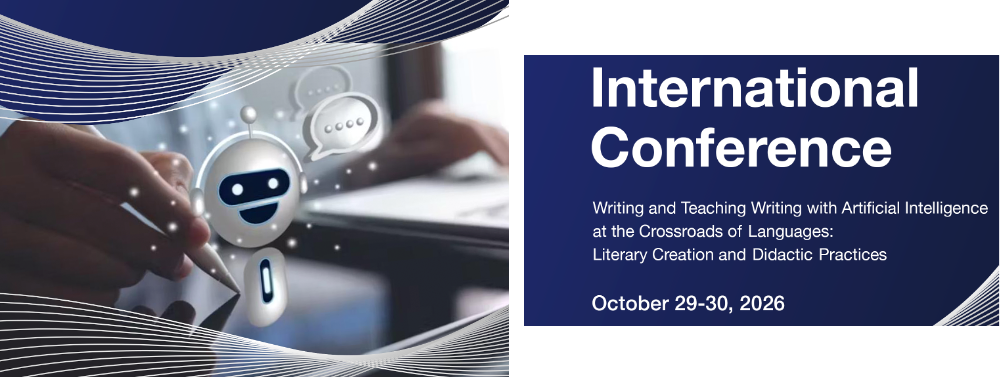
Call for papersThe emergence of artificial intelligence has profoundly transformed the act of writing into all its dimensions, from the learning of writing to its teaching. As a technical tool, creative assistant, space for reflection, or translation partner, artificial intelligence reshapes linguistic and literary practices, opens new imaginaries, and challenges the boundaries between languages, authors, cultures, and competencies. Historically, artificial intelligence has been approached through the lens of simulation. Göksel and Bozkurt (2019) define—albeit approximately—artificial intelligence as the capacity of a computer-controlled system to perform tasks in a manner like that of a human being. As they note, human qualities include mental processes such as reasoning, meaning-making, generalization, and learning from experience. Under the terms artificial intelligence or computational intelligence, Russell and Norvig (2003) encompass various subfields in which learning occurs and where specific tasks—such as playing chess, proving mathematical theorems, writing poetry, or diagnosing diseases—can be performed. Nilsson (2014) defines artificial intelligence as the construction of algorithmic systems that replicate human intelligence, emphasizing the development of models capable of processing information and transforming raw data into usable representations. Continuing this line of thought, LeCun, Bengio, and Hinton (2015) identify the major challenges of artificial intelligence as the learning of hierarchical representations, generalization, and the efficiency of deep learning models. However, the advent of large language models (LLMs) reconfigures these challenges by shifting attention toward language production, discursive interaction, and the educational and creative uses of artificial intelligence. Building on recent reflections on the temporalities of artificial intelligence—such as those discussed during the workshop Call for Papers: Temporalities of AI organized by the Bibliotheca Hertziana – Max Planck Institute for Art History (Rome, April 2026)—this conference focuses more specifically on the temporalities of writing, creation, and learning in the era of generative models. While existing research highlights the temporal regimes of neural networks, infrastructures, and algorithmic labor, our approach centers on the long durée of writing, the processes of meaning co-construction, the rhythms of language learning, and the narrative temporalities produced or reconfigured by artificial intelligence. Writing is no longer merely a matter of “sorting and ranking,” but of generation. As emphasized by Göksel and Bozkurt (2019) and Mattei and Villata (2022), although these systems rely on statistical probabilities rather than conscious intentionality, their integration into professional and creative practices calls for a redefinition of the act of writing. Writing becomes a space of human–machine interaction, a form of “co-writing” in which the boundary between human inspiration and algorithmic completion becomes increasingly blurred. The evolution of AI-based writing tools offers an unprecedented degree of personalization, capable of adapting to diverse styles, academic requirements, and linguistic preferences. This flexibility represents one of the major strengths of contemporary writing tools, enabling them to meet the varied needs of a wide range of users (Martinez, 2025). The domain of literature thus expands from classical forms emphasizing the autonomy of the work to socially and politically engaged writing, from the traditional novel to multimodal and interactive forms of writing, and from stylistic purity to reflections informed by anthropology, the sciences, and the creative capacities of artificial intelligence. The work of Alexandre Gefen (2010) illustrates this shift: “microblogging, as a brief, fluid, and asynchronous form of self-writing, […] leads to experimental constraint-based forms […] and pushes literature to leave spaces designed for literary expression and to assert itself within social dialogues.” The conference “Writing and Teaching Writing with Artificial Intelligence at the Crossroads of Languages – Literary Creation and Didactics” seeks to examine this zone of tension and cooperation: what remains of authorship, style, and learning when the machine is involved in meaning-making? The integration of artificial intelligence into pedagogical practices also opens new perspectives for didactic innovation and educational research. Baker et al. (2019) distinguish between AI uses oriented toward the system, the learner, and the teacher. Artificial intelligence is thus transforming the teaching of writing and language learning. For teachers, AI can generate texts adapted to different proficiency levels, create targeted exercises, and provide varied and customizable training materials. It also enables the design of flexible pedagogical scenarios, interactive activities, and diversified modes of assessment, while optimizing the time devoted to preparation and learner support. From the learners’ perspective, generative AI can be integrated into an active pedagogical approach in which students are directly involved in using technology to create, write, speak, or interact. AI can assist in producing original texts, suggesting reformulations, translating content, or generating dialogues. The integration of these tools into pedagogical and assessment practices raises new questions regarding educational innovation, learner creativity, and the evaluation of writing. This interdisciplinary international conference aims to bring together researchers, writers, teachers, and experts in linguistics, educational technologies, and language didactics to explore the role of artificial intelligence in writing, literary creation, and the teaching and learning of writing in first or foreign languages. Objectives
Thematic Axes Axis 1 — Writing with Artificial Intelligence: Literary Creation, Authorial Posture, and Plurilingualism This axis focuses on the artistic, cultural, creative, and identity-related dimensions of writing in digital and plurilingual contexts. It questions the figure of the author in the age of the machine and examines how artificial intelligence is embedded in individual or collective writing practices. This axis explores the transformation of the concept of authorship, and the aesthetics of hybrid works. Considering Barthes’ (1968) notion of the “death of the author,” can we paradoxically consider artificial intelligence as marking the “birth of the prompter”? Writing can no longer be viewed as an isolated and inspired act, but rather as a process of organization and dialogue with probabilistic automation.
Axis 2 — Teaching Writing with Artificial Intelligence: Pedagogy, Creative Writing, Didactics, Innovation, and Assessment This axis explores how artificial intelligence transforms teaching by shifting pedagogical focus from the final product to the process of composition (Sharples, 2022). It examines how AI can serve as scaffolding for language learning and creative writing, while critically addressing the potential loss of cognitive skills associated with manual writing (Baron, 2023). The introduction of generative AI raises fundamental tensions: while it can relieve teachers of content transmission tasks and personalize learning pathways (Romero et al., 2023), it may also encroach upon learner and teacher agency. Contributions are therefore invited to explore practices that foster critical distance from AI functioning, aiming at learner empowerment rather than digital alienation (Romero et al., 2023). Finally, we invite researchers to rethink assessment frameworks at a time when the authenticity of academic productions is being questioned (Bearman & Ajjawi, 2023; Karsenti, 2023), particularly by drawing on so-called “active pedagogies” to integrate AI (Romero et al., 2023).
Participation Modalities Possible Contributions: Within the framework of this conference, you may submit two types of proposals:
It is possible to submit both an oral presentation proposal and a poster proposal simultaneously. Each will be evaluated independently. All proposals will be subject to peer review. Required Format
Proposals must be submitted via the website: https://efeia.sciencesconf.org/ Adresse de contact : efeiafle@gmail.com Accepted Languages: French and English Timeline
Reference list: Baker, T., Smith, L., & Anissa, N. (2019). Educ-AI-tion rebooted? Exploring the future of artificial intelligence in schools and colleges. Nesta. Baron, N. S. (2023). Who wrote this? How AI and the lure of efficiency threaten human writing. Stanford University Press. Barthes, R. (1984). La mort de l’auteur. In Le bruissement de la langue. Éditions du Seuil. Bearman, M., & Ajjawi, R. (2023). Learning to work with the black box: Pedagogy for a world with artificial intelligence. British Journal of Educational Technology, 54(5), 1160–1173. Bibliotheca Hertziana – Max Planck Institute for Art History. (2026). Call for Papers: Temporalities of AI (workshop international, Rome, avril 2026). Gefen, A. (2010). Ce que les réseaux font à la littérature. Itinéraires, (2), 155–166. Göksel, N., & Bozkurt, A. (2019). Artificial intelligence in education: Current insights and future perspectives. In S. Sisman-Ugur & G. Kurubacak (Eds.), Handbook of research on learning in the age of transhumanism (pp. 224–236). IGI Global. Karsenti, T. (2018). Intelligence artificielle en éducation : l’urgence de préparer les futurs enseignants d’aujourd’hui pour l’école de demain ? Formation et profession, 26(3), 112–119. LeCun, Y., Bengio, Y., & Hinton, G. (2015). Deep learning. Nature, 521(7553), 436–444. Martinez, P. (2025). L’IA au cœur de la remise en question des méthodologies actuelles d’enseignement-apprentissage des langues et des cultures – Vers une didactique réticulaire. Alsic, 28(1), 1–40. Nilsson, N. J. (2014). Principles of artificial intelligence. Morgan Kaufmann. Romero, M., Heiser, L., & Lepage, A. (Eds.). (2023). Enseigner et apprendre à l’ère de l’intelligence artificielle. Canopé. Russell, S. J., & Norvig, P. (2003). Artificial intelligence: A modern approach (2nd ed.). Pearson Education. Sharples, M. (2022). Automated essay writing: An AIED opinion. International Journal of Artificial Intelligence in Education, 32(4), 1119–1126. Indicative supplementary bibliography: Azilan, I., & Anaté, K. (2025). L’intelligence artificielle générative et la robotisation littéraire : Enjeux de la délégation de la créativité. Communication, technologies et développement, (18). Fülöp, E. (2024a). Écrire-avec l’intelligence artificielle, ou l’esthéthique de la sympoïèse. Nouveaux cahiers de Marge, (8). Fülöp, E. (2024b). (S’) écrire réseau : Une autorésographie. Revue des sciences humaines, (352). Gabaret, J. (2025). L’art des IA. Presses Universitaires de France. Gefen, A. (2023). Créativités artificielles : La littérature et l’art à l’heure de l’intelligence artificielle. Les presses du réel. Gefen, A. (2025). Littérature et intelligence artificielle. Dans J.-L. Giavitto & P. Saint-Germier (Dirs.), L’art au temps de l’IA. Éditions du Centre Pompidou. Méadel, C., & Sonnac, N. (2012). L’auteur au temps du numérique. Esprit, (5), 102–114.
Parmentier, S. (2025). Quand l’IA tue la littérature. PUF. Pickover, C.-A. (2021). La fabuleuse histoire de l’intelligence artificielle : Des automates aux robots humanoïdes. Dunod. Saemmer, A. (2020). De l’architexte au computexte : Poétiques du texte numérique face à l’évolution des dispositifs. Communication & langages, 203(1), 99–114. Saemmer, A. (2022). Vers une poétique post-numérique de l’illisibilité. Recherches et Travaux, (100). |