|
Welcome
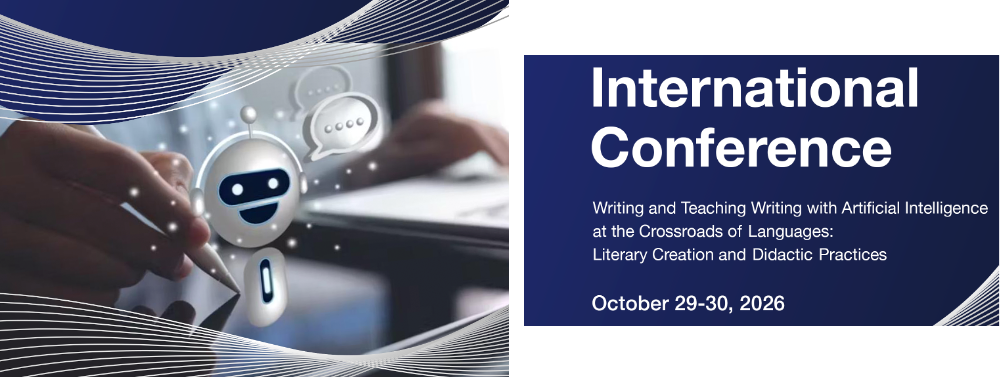
International Conference
Writing and Teaching Writing with Artificial Intelligence at the Crossroads of Languages: Literary Creation and Didactic Practices
The emergence of artificial intelligence has profoundly transformed the act of writing into all its dimensions, from the learning of writing to its teaching. As a technical tool, creative assistant, space for reflection, or translation partner, artificial intelligence reshapes linguistic and literary practices, opens new imaginaries, and challenges the boundaries between languages, authors, cultures, and competencies. Historically, artificial intelligence has been approached through the lens of simulation. Göksel and Bozkurt (2019) define—albeit approximately—artificial intelligence as the capacity of a computer-controlled system to perform tasks in a manner like that of a human being. As they note, human qualities include mental processes such as reasoning, meaning-making, generalization, and learning from experience. Under the terms artificial intelligence or computational intelligence, Russell and Norvig (2003) encompass various subfields in which learning occurs and where specific tasks—such as playing chess, proving mathematical theorems, writing poetry, or diagnosing diseases—can be performed. Nilsson (2014) defines artificial intelligence as the construction of algorithmic systems that replicate human intelligence, emphasizing the development of models capable of processing information and transforming raw data into usable representations. Continuing this line of thought, LeCun, Bengio, and Hinton (2015) identify the major challenges of artificial intelligence as the learning of hierarchical representations, generalization, and the efficiency of deep learning models. However, the advent of large language models (LLMs) reconfigures these challenges by shifting attention toward language production, discursive interaction, and the educational and creative uses of artificial intelligence. Building on recent reflections on the temporalities of artificial intelligence—such as those discussed during the workshop Call for Papers: Temporalities of AI organized by the Bibliotheca Hertziana – Max Planck Institute for Art History (Rome, April 2026)—this conference focuses more specifically on the temporalities of writing, creation, and learning in the era of generative models. While existing research highlights the temporal regimes of neural networks, infrastructures, and algorithmic labor, our approach centers on the long durée of writing, the processes of meaning co-construction, the rhythms of language learning, and the narrative temporalities produced or reconfigured by artificial intelligence. Writing is no longer merely a matter of “sorting and ranking,” but of generation. As emphasized by Göksel and Bozkurt (2019) and Mattei and Villata (2022), although these systems rely on statistical probabilities rather than conscious intentionality, their integration into professional and creative practices calls for a redefinition of the act of writing. Writing becomes a space of human–machine interaction, a form of “co-writing” in which the boundary between human inspiration and algorithmic completion becomes increasingly blurred. The evolution of AI-based writing tools offers an unprecedented degree of personalization, capable of adapting to diverse styles, academic requirements, and linguistic preferences. This flexibility represents one of the major strengths of contemporary writing tools, enabling them to meet the varied needs of a wide range of users (Martinez, 2025). The domain of literature thus expands from classical forms emphasizing the autonomy of the work to socially and politically engaged writing, from the traditional novel to multimodal and interactive forms of writing, and from stylistic purity to reflections informed by anthropology, the sciences, and the creative capacities of artificial intelligence. The work of Alexandre Gefen (2010) illustrates this shift: “microblogging, as a brief, fluid, and asynchronous form of self-writing, […] leads to experimental constraint-based forms […] and pushes literature to leave spaces designed for literary expression and to assert itself within social dialogues.” The conference “Writing and Teaching Writing with Artificial Intelligence at the Crossroads of Languages – Literary Creation and Didactics” seeks to examine this zone of tension and cooperation: what remains of authorship, style, and learning when the machine is involved in meaning-making? The integration of artificial intelligence into pedagogical practices also opens new perspectives for didactic innovation and educational research. Baker et al. (2019) distinguish between AI uses oriented toward the system, the learner, and the teacher. Artificial intelligence is thus transforming the teaching of writing and language learning. For teachers, AI can generate texts adapted to different proficiency levels, create targeted exercises, and provide varied and customizable training materials. It also enables the design of flexible pedagogical scenarios, interactive activities, and diversified modes of assessment, while optimizing the time devoted to preparation and learner support. From the learners’ perspective, generative AI can be integrated into an active pedagogical approach in which students are directly involved in using technology to create, write, speak, or interact. AI can assist in producing original texts, suggesting reformulations, translating content, or generating dialogues. The integration of these tools into pedagogical and assessment practices raises new questions regarding educational innovation, learner creativity, and the evaluation of writing. This interdisciplinary international conference aims to bring together researchers, writers, teachers, and experts in linguistics, educational technologies, and language didactics to explore the role of artificial intelligence in writing, literary creation, and the teaching and learning of writing in first or foreign languages.
|